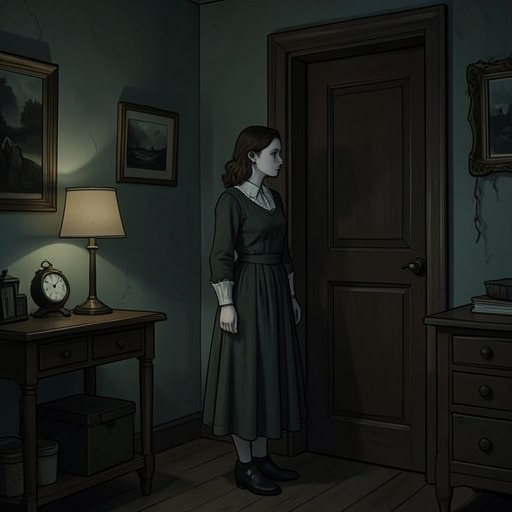
Johnny Kleintjes and Monica Kleintjes: father and daughter
Heart of the HunterJohnny Kleintjes and Monica Kleintjes are father and daughter, and their relationship turns on a practical, hard-won trust: they share a home, he chooses her as the person to prepare for danger, and she acts to help him when his work becomes a threat. Monica does not understand the contents or purpose of the files at the centre of the crisis, but her loyalty to her father brings her into the chain of events that carries them beyond his house.
Family and Background
Johnny Kleintjes was an intelligence specialist whose career began in exile and later brought him into the work of combining intelligence databases. He and his wife had one child, Monica Kleintjes. After his wife died of cancer, Johnny Kleintjes retired at sixty-two in 1997 and shared a house with his daughter. Their home is therefore not merely a setting for the later crisis: it is the place where Monica learns of his anxieties and where he keeps the hard disk whose custody will place her under pressure.
Monica Kleintjes was born in London in 1974, attended school there, and completed computer-science studies in 1995. A motor accident outside Manchester in 1980 cost her both legs. She uses prosthetic limbs and refuses crutches or other aids; by the time the intelligence investigation focuses on her, she is a senior manager in the technology division of Sanlam. These details establish her as an independent professional, not simply an extension of her father’s life. Yet the family connection becomes decisive when Johnny Kleintjes entrusts her with information and responsibility he has not shared with others.
A Household Shaped by His Work
After the elections, the integration of the intelligence services was difficult. The new project required disparate records to be consolidated, including material from former government and liberation-movement systems. Johnny Kleintjes was put in charge of combining the computer records into a central database. The scale was immense: the material amounted to an estimated four or five hundred gigabytes and included public information, weapons systems, informants, and double agents. Monica Kleintjes kept house for her father during this period, when her mother was ill, and saw that the information weighed on him.
Johnny Kleintjes told his daughter that some orders troubled him and that he feared certain actions would not be approved by Nelson Mandela and Nzo. Amid confusion, institutional rivalry, and efforts to protect careers, he began making backups of some material on hard disks and sometimes worked on them through the night. Monica Kleintjes deliberately kept out of the details. She later made clear that she did not know what was on the disks or what her father intended to do with the data. Her account preserves an important distinction: she was close enough to witness his distress, but not a partner in the decisions he made about the files.
Trust Prepared for a Crisis
Johnny Kleintjes’s confidence in his daughter becomes visible in the precautions he takes. Two or three weeks before the crisis, he came to Monica Kleintjes at work, something he had never done before. He carried a piece of paper with the name and telephone number of someone he trusted completely. He told her to contact that person if anything happened to him, while avoiding an explanation of what danger he anticipated. When she pressed him, he redirected the conversation to her office rather than disclose more.
The instruction was preserved in the most consequential place: when Monica Kleintjes opened the safe to retrieve the hard disk, she found a note on top of it bearing Thobela Mpayipheli’s name and number. She called him, then took the disk to him in Guguletu. The journey from her father’s private warning to her concrete action shows the way their trust operates. Johnny Kleintjes did not tell her what the data contained, but he gave her a clear contingency and a contact he believed she could rely on. Monica Kleintjes followed that plan when the danger became immediate.
Threat, Loyalty, and the Disk
The threat against Johnny Kleintjes was communicated directly to Monica Kleintjes: she was told that her father was in trouble because he had promised something he could not deliver, and that he would be killed if she did not cooperate. The hard disk in the safe was identified as the object wanted from her. The threat transformed a private family precaution into an urgent choice. Monica Kleintjes was not acting with full knowledge of the material; she was responding to the danger to her father and to the instructions he had left.
Later, at her father’s house, Monica Kleintjes was visibly distressed as Williams tried to reassure her. He acknowledged that he would have acted the same way for his own father and described her action as noble. The questions put to her concerned both Johnny Kleintjes’s relationship with Thobela Mpayipheli and the nature of the data he had taken. In answering them, Monica Kleintjes returned to the limits of what she knew: she suspected her father had not handed in the disks and might have been trying to sell the information, but she could not say what the files contained or what he intended. Her loyalty is not presented as certainty about his conduct; it is a willingness to help him despite uncertainty.
Significance of Their Relationship
The father–daughter relationship joins the book’s public intelligence conflict to a domestic bond. The extensive databases and competing institutions may be abstract, but their consequences arrive at the family home, in the safe, on a note, and in a call that threatens a parent’s life. Monica Kleintjes’s role is consequential precisely because she has not been initiated into her father’s work. She becomes a messenger and custodian through the confidence he places in her, not through expertise in the secrets themselves.
Their relationship also contains a careful asymmetry. Johnny Kleintjes shares enough to prepare Monica Kleintjes for an emergency, yet withholds the substance of his actions; she respects that boundary and then acts on the trust he has shown. Her decision to retrieve and deliver the hard disk does not resolve the uncertainty surrounding his motives or the files. It does, however, make the father’s earlier confidence consequential: the contingency he prepared becomes the means by which his daughter tries to protect him.